
Nissan just pulled the covers off one of its most important launches in years, and it isn’t happening in Japan, Europe, or the US. It’s happening in India. The all-new Nissan Tekton had its global premiere on July 9, 2026, and it’s shaping up to be the vehicle Nissan is betting its comeback story on in one of the world’s most brutally competitive car markets.
If the name sounds unfamiliar, that’s because it’s brand new. Nissan drew it from a Greek word meaning “craftsman” or “builder,” which the company says reflects its approach to precision engineering. Whatever the branding language, the real story is simpler: this is Nissan’s attempt to build a small SUV with the visual presence of something much bigger, at a price almost nobody expected.
Table of Contents
A Baby Patrol, Built on Duster Bones
The Tekton is a mid-size SUV developed and built in India through Nissan’s alliance with Renault, and mechanically it shares its foundation with the third-generation Dacia Duster and its Renault-badged twin sold in India. That means it rides on the CMF-B platform, a versatile architecture used across the Renault-Nissan-Mitsubishi alliance for exactly this kind of compact, cost-conscious SUV.
What makes the Tekton stand out from its Duster and Renault relatives is the styling, which borrows heavily from Nissan’s flagship off-roader, the Patrol (sold as the Armada in North America). Nissan’s design team has been explicit that they wanted the Tekton to read as a “baby Patrol,” and it shows in the details: a sculpted hood, C-shaped LED headlights, a bold grille with chrome accents, and a full-width light bar connecting the taillights at the rear. The side profile keeps the familiar Duster silhouette, but Nissan added its own touches, including unique side gills and a distinct set of multi-spoke alloy wheels.
Inside, the cabin uses body-colored trim mixed with gloss black and metal-look accents, and higher trims lean into a genuinely upscale feel for the segment: leatherette upholstery, contrast stitching, and even a striking white-and-purple color scheme with copper accents on the range-topping trim. It’s an unusual combination, but it signals that Nissan wants this car to feel like more than a rebadged budget SUV, even though that’s exactly what sits underneath.
Power, Efficiency, and What You Actually Get
The Tekton comes exclusively with front-wheel drive and a pair of turbocharged petrol engines — no diesel, and for now, no hybrid. The base engine is a 1.0-liter turbo producing around 100 horsepower, paired with a 6-speed manual gearbox. Buyers who want more shove can step up to a 1.3-liter turbo good for roughly 163 horsepower, offered with either a manual or a 6-speed dual-clutch automatic. Fuel efficiency for the base engine comes in at around 19.4 km per liter, which is respectable for the class, even if it isn’t chasing hybrid-level numbers.
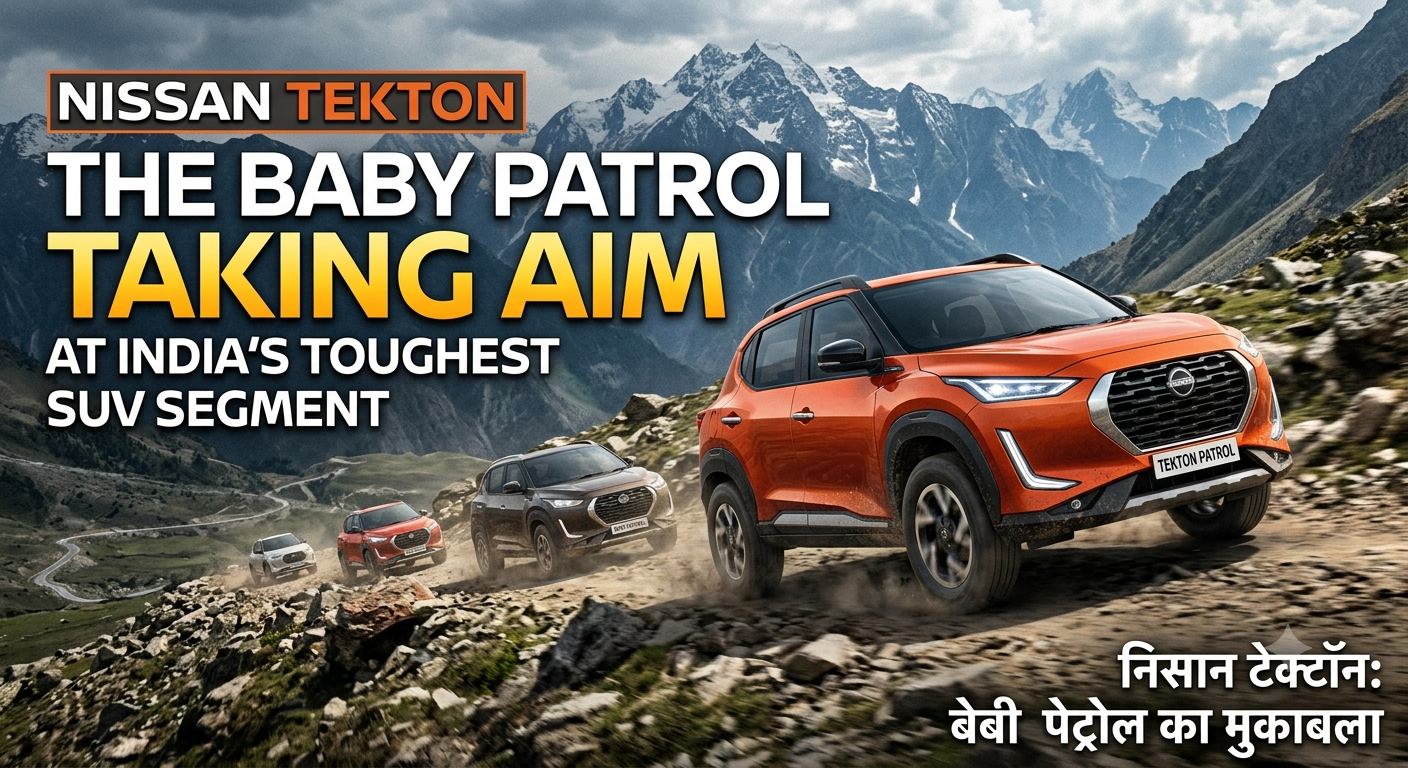
Notably absent is all-wheel drive. Despite the rugged, Patrol-inspired styling, the Tekton is a front-wheel-drive-only proposition, which puts a fairly hard limit on how seriously off-road-capable buyers should expect it to be. This is a city-and-highway SUV wearing an adventure-ready costume, not a genuine trail vehicle.
Where the Tekton does impress is safety and technology, especially at its price point. It comes with six airbags across the range, a 5-star Bharat NCAP safety rating, and on higher trims, a full suite of driver-assistance features including adaptive cruise control, lane-keeping assistance, automatic emergency braking, blind-spot monitoring, and a 360-degree camera system built from a dozen sensors and four cameras. Higher trims also add a panoramic sunroof, ventilated and power-adjustable front seats, dual-zone climate control with a smart air purifier, and Google built-in for navigation, voice assistant, and app access — the kind of feature set that used to be reserved for cars costing considerably more.
The Price Is the Real Headline
If there’s one number that makes the Tekton newsworthy outside India, it’s the starting price. The entry-level Visia trim starts at around 10.49 lakh rupees, which converts to roughly $11,000. The range-topping Tekna+ trim, with the larger engine and automatic transmission, tops out at about 18.59 lakh rupees, or roughly $19,500. By the standards of most global markets, those are hatchback prices attached to a vehicle with genuine SUV proportions and a lengthy features list.
That pricing places the Tekton directly against some of the fiercest competition in the automotive world: the Hyundai Creta, Kia Seltos, Toyota Urban Cruiser Hyryder, Maruti Suzuki Grand Vitara and Victoris, Tata Sierra, Skoda Kushaq, Honda Elevate, Volkswagen Taigun, and MG Astor, among others. India’s mid-size SUV segment is arguably the single most contested category in the global car market, and Nissan is entering it with a vehicle it clearly hopes can punch above its underlying platform.
Built in India, Bound for the World
The Tekton isn’t just an India story. It’s manufactured at the Renault-Nissan alliance plant in Chennai, and Nissan has confirmed plans to export it to more than 50 markets across the Middle East and Africa. That export ambition is central to Nissan’s broader “One Car, One World” strategy, which uses India as both a growth market in its own right and a manufacturing hub that can supply comparable emerging markets elsewhere.
Nissan also has more in store for the platform. A seven-seat version, expected to be a rebadged take on the Renault Boreal, is reportedly planned for a 2027 debut, which would give the Tekton family a larger sibling for buyers who need extra rows of seating.
The Bottom Line
The Nissan Tekton is a calculated bet: take a proven, cost-effective platform already validated by the Dacia Duster and Renault Duster, wrap it in styling borrowed from one of Nissan’s most respected nameplates, load it with tech and safety features that outclass its price point, and let the value proposition do the talking. It won’t satisfy buyers looking for genuine off-road capability or all-wheel-drive security, and enthusiasts will recognize the Duster underneath the design flourishes. But for budget-conscious SUV shoppers in India and the markets Nissan plans to export to, the Tekton looks like exactly the kind of disruptor the segment has been waiting for — a lot of SUV presence for not a lot of money.
Also Read – The Best Car to Buy in 2026: Why the Toyota Camry Hybrid Leads the Pack